
 Warnings
 Construction
 Weather
 Contact
 Search
Lovrenc na Pohorju
Lovrenc lies in a depression on the north side of Pohorje. Lovrenc includes 7 settlements: Činžat, Kumen, Lovrenc na Pohorju, Puščava, Rdeči breg (part), Recenjak, Ruta.
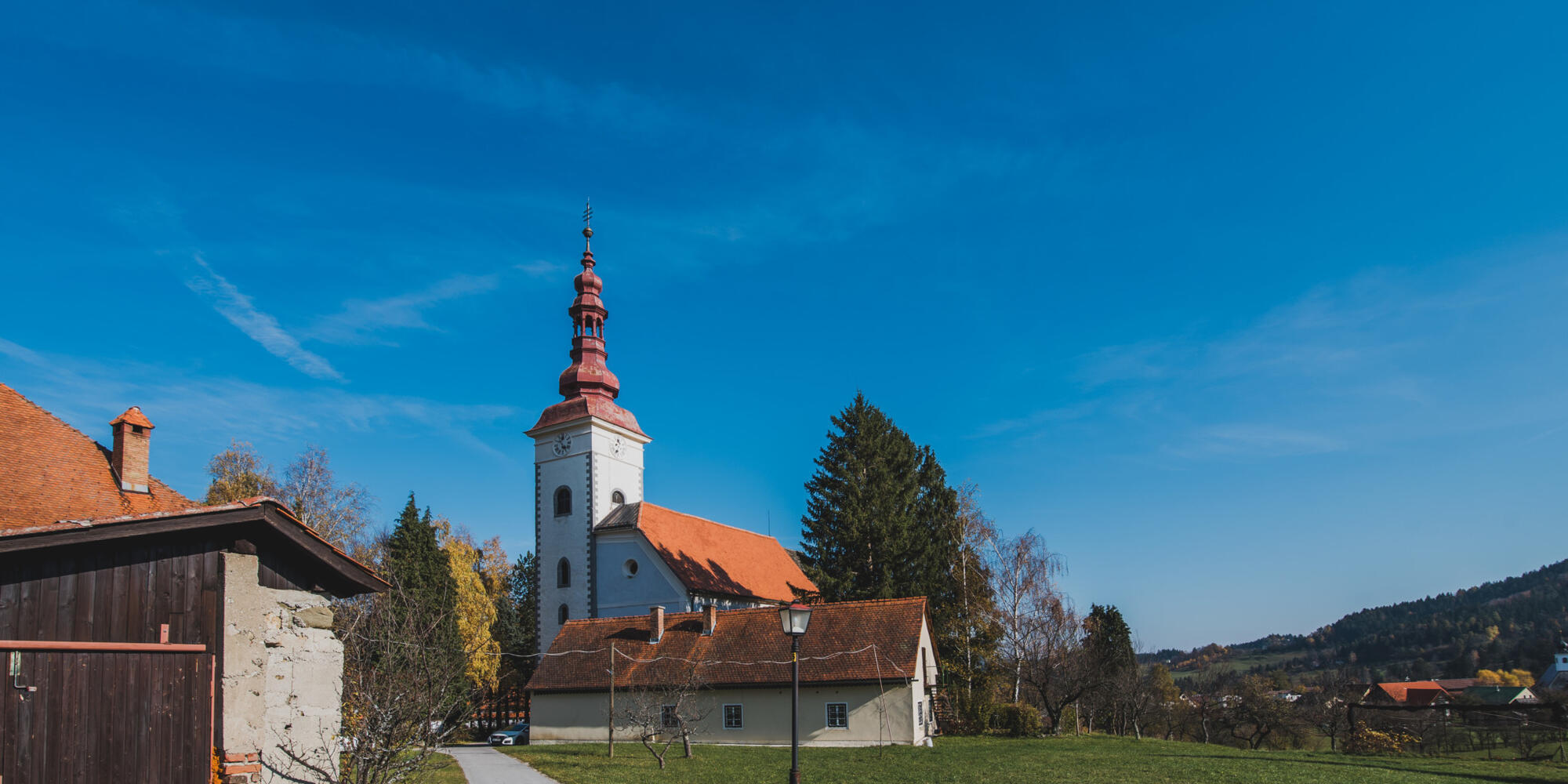
Because of its location, Lovrenc became something special through time. We find numerous sacral objects in the municipality, which they are still proud of today. Among them is the parish church of Saint Lawrence, which gave the town its name.
Cultural heritage
Parish Church of St. Lawrence
The church after which the town was named was first mentioned in 1184, and became a parish in 1191. The main altar is dedicated to the patron saint of St. Lawrence. Nothing is known about this Romanesque church, however, there is information about its Gothic successor from the first quarter of the 15th century. The lower part of the west and the south naval wall and a piece of rib embedded in the walls of the presbytery are retained. In the first half of the 16th century, a 5-storey bell tower was added to the church, and then the church was partially burnt. There are 48 statues, paintings, reliefs and angels in it. It was given its present form in the 18th century and is almost entirely a unique Baroque church, supplemented by the rich Baroque equipment, the work of the renowned sculptor Jožef Holzinger.
Branch Church of St. Radegunda
The originally modest Gothic church from the 17th century was on the request of the abbot enlarged and the nave decorated with arches. It was given its present form in 1776 and contains the altars of St. Radegunda, Virgin Mary and St. Catherine.
Branch Church of St. Cross
The church was first mentioned in the 13th century; however, the present church is already of late Baroque from 1659. Subsequently a bell tower and sacristy were added. On the closing wall of the presbytery there are the remains of the frescoes of Mary and John the Evangelist, and in the middle there is a large and quality Baroque crucifix. The church also houses the altar of St. Florian, where the people of Sveti Križ often sought shelter from fire.
Branch Church of St. Ignatius on the Red Bank
The original wooden church, which was built by the Benedictines, was in 1769 replaced by a stone one. It was built out of fear that Luther's faith would spread around the area. In the main altar of the church there is the Baroque painting of St. Ignatius, on the right side of the "Šmohorski" altar, and on the left the altar of the Mother of God. On the walls, there are the Joseph’s Stations of the Cross. The church is the only one in Slovenia that is dedicated to the founder of the Jesuit Order of St. Ignatius of Loyola.
Statue of St. Nicholas
Next to the road in Gornji trg stands a stone Baroque statue of St. Nicholas, the protector of rafters, which reminds of the headquarters of the rafting guild in the area.
Parish Church of Virgin Mary in the Desert
The Pilgrimage Church in the Desert represents the top art of the 17th century in the Podravje region and is also one of the most important monuments of the famous Renaissance and early Baroque Architecture in Slovenia. The interior of the large church consists of a three-nave space and the eastern part is formed by semi-circular chapels and a semi-circular presbytery. On the main altar there is the statue of Mary's group, which is the work of the sculptor Joseph Straub. There are five altars, and all the statues are wooden, golden and surrounded by angels.
Branch Church of St. Anne in the Desert
Above the Church of the Virgin Mary we are welcomed by a roof bell tower of the chapel of St. Anne on the hill, which was built in 1659, but is today partly Baroque and partly historical.
Ladejenkovo
Ladejenkovo is the oldest house in Lovrenc, about 500 years old. It lies in the hamlet of Puša, which is one of the oldest hamlets in the area. This authentic farm house from the 15th century is almost entirely wooden, built from brushwood. The windows are square shaped, protected by Baroque forged nets. The house is covered with a mighty, steep, tuft-like, “šintlasta” roof. The smokehouse was preserved until the First World War. The floors are wooden. In 1991, the roof was restored with the help of the Institute for Natural and Cultural Heritage. In the museum part of the building, there is, since 2011, an exhibition dedicated to a special character from Lovrenc, Jakop Paulic - Sadonik, who was born in 1876 and died in 1948. He was a self-taught person, a pilgrim, a historian, a newspaper reporter and a great fan of books. The legacy consists mainly of German books and literature with religious content.
Pajštva – fruit dryer
To this day, more than 100 years old Pohorje pajštva has been preserved, which stands between the parish church of St. Lawrence and the cemetery and in which fruits and flax were dried. It is partly stone and partly wooden built. The roofing is assembled and connected without nails, only with wooden wedges or hobnails and covered with old brick. The fruit was dried in the interior on special wooden boards and the fire was set outside. The specialty of the pajštva is that there is no upright chimney, but rather two openings under the arched fireplace, which served as a smokestack. The pajštva is an ethnological monument.
Natural heritage
Lovrenc Lakes
At the top of Pohorje, at the foothills of Radoljna, Mislinja and Velka Rivers, there lies a peat bog with 11 to 22 ponds, depending on the volume and durability of still water. This typical reef mud, formed 6,000 years ago, has turned from a mineral swamp into high marshes with the peat reaching up to 290 cm. The bigger part of the 16 hectare of the large peat is covered with dwarf pine and the characteristic species of high marshes: rosemary, round-leaved sundew, various types of peat mosses, alpine stud and other. The Lovrenc moor is the largest one in Slovenia and the southernmost moor in Europe on a silicate basis. It is part of the forest reserve Lovrenc Lakes.
Trees
There are several trees growing in the surrounding area, which with their unusual shape, exceptional size or rarity attract attention: Trjenk linden, Grobelnik yew, Hajšek beech, Hožič linden, Hožič yellow dogwood, Jodl's yew, Kapus chestnuts, Kogler linden, Metajk’s yew, Ropič’s oak , Ropič’s spruce, Ropič’s yew, Verovnik's yew.
Services nearby (10km)










To spletno mesto uporablja piškotke, ki izboljšajo vašo izkušnjo. Kaj so piškotki?
Nastavitve piškotkov
To spletno mesto uporablja piškotke, ki izboljšajo vašo izkušnjo. Kaj so piškotki?
Zahtevani piškotki
Ti piškotki so nujni za delovanje naše spletne strani in jih ni mogoče izključiti.
Oglaševalski piškotki
Te piškotke lahko na našo stran postavijo oglaševalski partnerji in s pomočjo njih prikažejo relevantne oglase.
Analitični piškotki
Omogočajo anonimizirano zbiranje podatkov o obisku spletne strani. Nastavi jih lahko tretja oseba, katere storitve uporabljamo.